

A Hospitality Model Without Food Costs
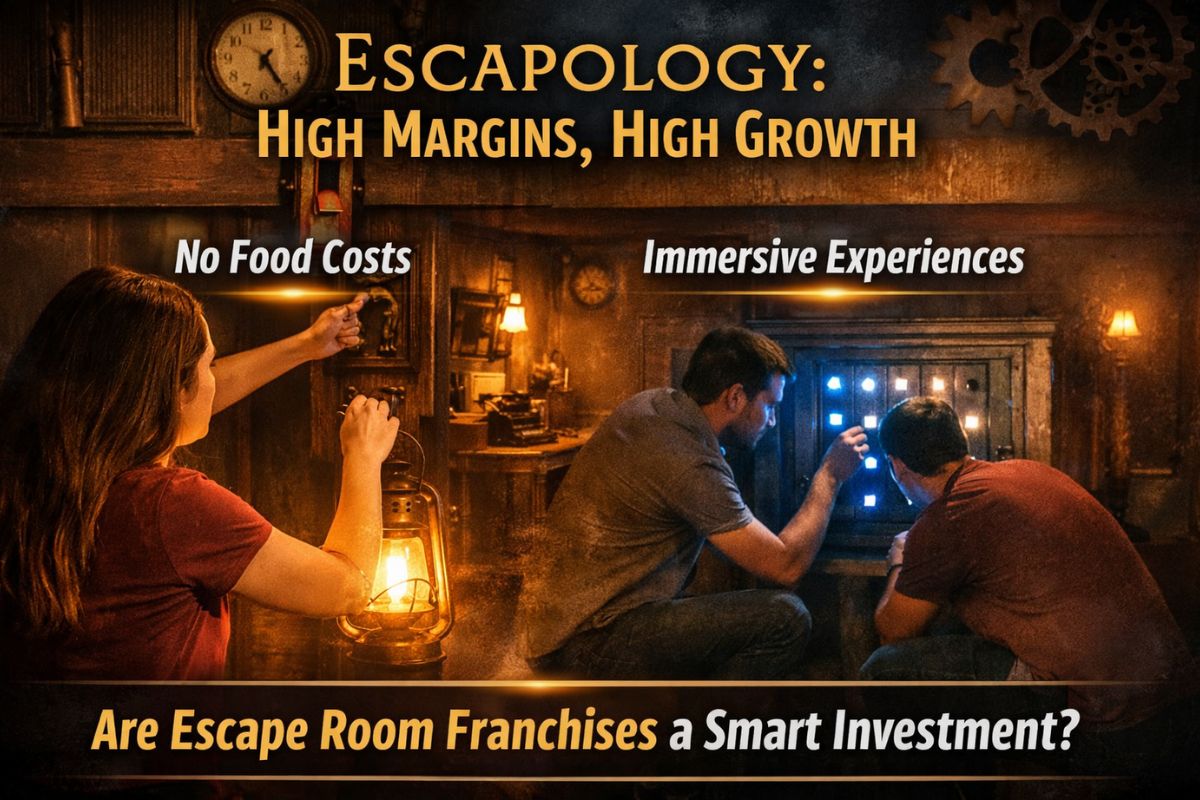
Escapology CEO Burton Heiss says the brand immediately stood out to him because it looked like a restaurant business — without one of its biggest challenges.
“When I first learned about Escapology, my first thought was, ‘This is the restaurant business without food costs,’” Heiss said in a recent interview with 1851 Franchise publisher Nick Powills.
In traditional restaurants, food costs can range from the low 20% range to as high as 30%, significantly cutting into profits. Removing that expense gives operators more room to grow, experiment, and weather challenges.
“That margin gives you much more room for error,” Heiss said. “Instead of constantly squeezing costs, you can focus on building something sustainable and scalable.”
From Restaurants to Escape Rooms
Heiss brings decades of hospitality experience to Escapology. After spending his career in the restaurant industry, he joined the brand when a private equity group acquired a majority stake and asked him to get involved.
Although he had limited executive experience in franchising, Heiss was drawn to the product, the untapped market opportunity, and the brand’s growth potential.
“I didn’t want to consult from the outside,” he said. “I wanted to jump in and build something.”
Addressing the ‘Fad’ Question
Escape rooms are sometimes labeled as a short-term trend, but Heiss disagrees. He explains that while the industry experienced early boom-and-bust cycles, the overall number of escape room venues has remained stable for years.
“Fads are defined by sharp rises and sudden collapses,” Heiss said. “That already happened. What we see now is stability.”
Heiss noted that many independent escape rooms failed not because the category was weak, but because they lacked the systems, capital, and operational discipline needed to keep up with rapid changes in technology, real estate, and customer expectations.
Built for Franchising
Unlike businesses such as pizza restaurants, which can succeed independently, escape rooms require complex infrastructure — from game design and theming to technology and storytelling.
Heiss compared it to opening a pizza shop where the owner must first build their own oven.
“That complexity creates a natural moat,” he said. “Franchisees need a system, and that’s where Escapology excels.”
By solving those challenges at the corporate level, Escapology gives franchisees a turnkey model with a higher chance of success.
Why Corporate Locations Matter
Escapology operates 20 corporate-owned locations, which Heiss says is critical to the brand’s success. These locations act as testing grounds for new games, themes, and initiatives before rolling them out systemwide.
Also read: Ford’s Garage Opens New Franchise Restaurant in Sanford, Florida
“Being a larger operator makes us a better franchisor,” Heiss said. “If something doesn’t work, we find out first. If it does work, we can prove it with data.”
This approach allows Escapology to roll out only proven ideas, reducing risk for franchisees.
A Network Built on Trust and Reinvestment
According to Heiss, one of the brand’s biggest strengths is its franchisee network. Prospective owners often change their perspective after speaking directly with existing operators.
“We’re very open,” Heiss said. “It’s a relationship-driven system.”
He added that the brand’s strong unit economics help reduce long-term risk. Faster payback periods make franchisees less vulnerable to market shifts, and the fact that owners are renewing and reinvesting speaks to the brand’s durability.
Also Read: How Shipley Do-Nuts Plans to Grow With Data-Driven Marketing
What Do You Think?
Q: Do you think high-margin entertainment franchises like Escapology are a safer investment than traditional food-based hospitality brands?
Ans: ??????

