

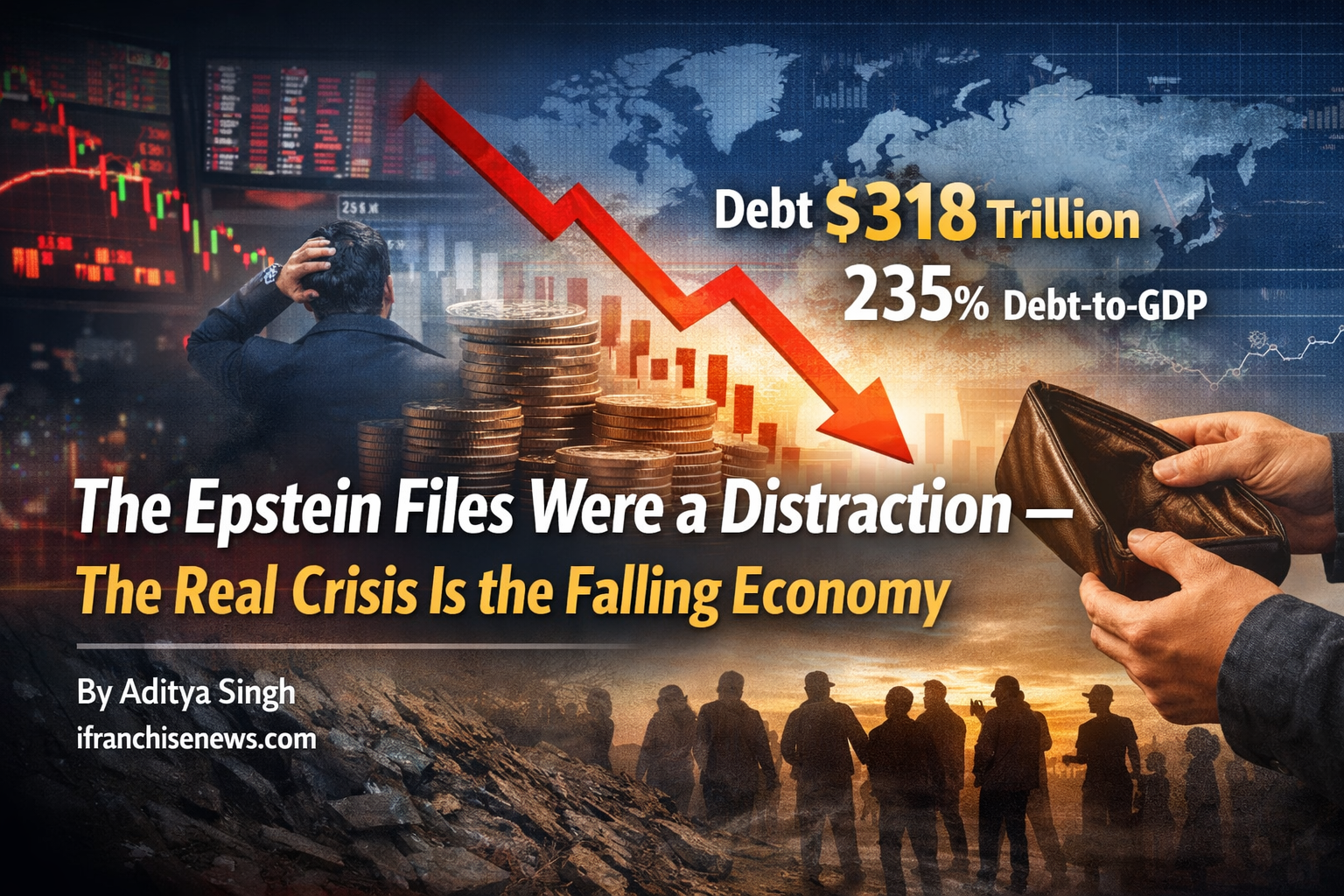
- Global News By ifranchisenews-: (The Epstein Files Jast a Distraction) As global media cycles continue to spotlight sensational controversies, a far more serious issue is unfolding quietly in the background — the steady weakening of the world economy.
While stories like the Epstein files dominate attention and public debate, economic indicators point toward rising debt, slowing trade, and growing job insecurity. These are not distant risks. They are present-day realities affecting businesses, governments, and households worldwide.
Global Debt Is at a Historic High
One of the strongest signals of economic stress today is the scale of global debt.
Debt Bigger Than the World Economy
Global debt — including government, corporate, and household borrowing — has crossed $318 trillion, growing nearly 50% over the past decade. In comparison, global GDP stands at roughly $110 trillion.
This means total debt is now more than 235% of global GDP, a level usually seen only during major economic crises. Simply put, the world owes more than twice what it produces in a year.
Major Economies Carry the Heaviest Burden
The debt problem is not limited to developing nations. Some of the world’s largest economies are among the most leveraged.
Country-Level Debt Snapshot
- United States: Over $38 trillion in public debt — the highest in the world
- China: Approximately $18.7 trillion in government debt
- Japan: Debt at nearly 230% of GDP, one of the highest ratios globally
- India: Government debt around 81–82% of GDP, with planned borrowing of about ₹17.2 trillion in the current fiscal cycle
High debt limits a government’s ability to invest in growth, infrastructure, and employment — especially when interest rates remain elevated.
Rising Interest Costs Are Squeezing Growth
Debt becomes dangerous when repayment costs rise faster than income.
Interest Payments Are Overtaking Priorities
In several developed economies, government interest payments now consume over 3% of GDP, surpassing spending on housing, infrastructure, and even defence in some cases.
For businesses, higher interest rates mean:
- Costlier loans
- Reduced expansion
- Lower risk appetite
For consumers, it means higher EMIs, weaker spending, and declining confidence.
Global Trade Is Losing Momentum
Trade, once the engine of global growth, is slowing.
Geopolitical Risk and Supply Chain Stress
Trade disruptions, sanctions, and regional conflicts have weakened global supply chains. Export-oriented industries are facing uncertainty in demand, pricing, and logistics.
Lower trade volumes directly affect manufacturing, logistics, and employment — particularly in emerging economies.
Jobs and Businesses Feel the Pressure
Economic slowdown always reaches the job market first.
Hiring Slowdowns and Job Insecurity
Across industries, companies are cautious. Hiring freezes, layoffs, and contract-based employment are increasing. Young professionals and skilled workers face delayed opportunities and unstable career paths.
Small Businesses and Franchises Under Stress
Small businesses, startups, and franchise operators are struggling with:
- Rising operating costs
- Limited access to affordable credit
- Softening consumer demand
These businesses are critical job creators, and their slowdown signals broader economic weakness.
Why Distractions Are Dangerous
The risk of focusing on sensational headlines is not just misplaced attention — it is delayed action.
Economic decline rarely announces itself loudly. It advances gradually, while public focus shifts elsewhere. When attention returns, the damage is often already done.
News in Brief : The Economy Is the Real Headline
The Epstein files may dominate headlines, but they do not determine job creation, trade stability, or household income.
The real crisis is visible in the numbers:
- $318 trillion in global debt
- Debt exceeding 235% of world GDP
- Rising interest burdens
- Slowing trade and uncertain jobs
These are the forces shaping the future of economies and businesses worldwide.
The greatest risk today is not controversy — it is complacency. The economy demands attention, policy focus, and long-term planning now. Ignoring it may prove to be the most costly distraction of all.
Disclaimer:
This article reflects the author’s personal analysis and opinions based on publicly available economic data. It is intended for informational purposes only and should not be considered financial, investment, or legal advice.
Also Read: Canada Invests Billions in Electric Cars Following Trump’s Tariff Decision

